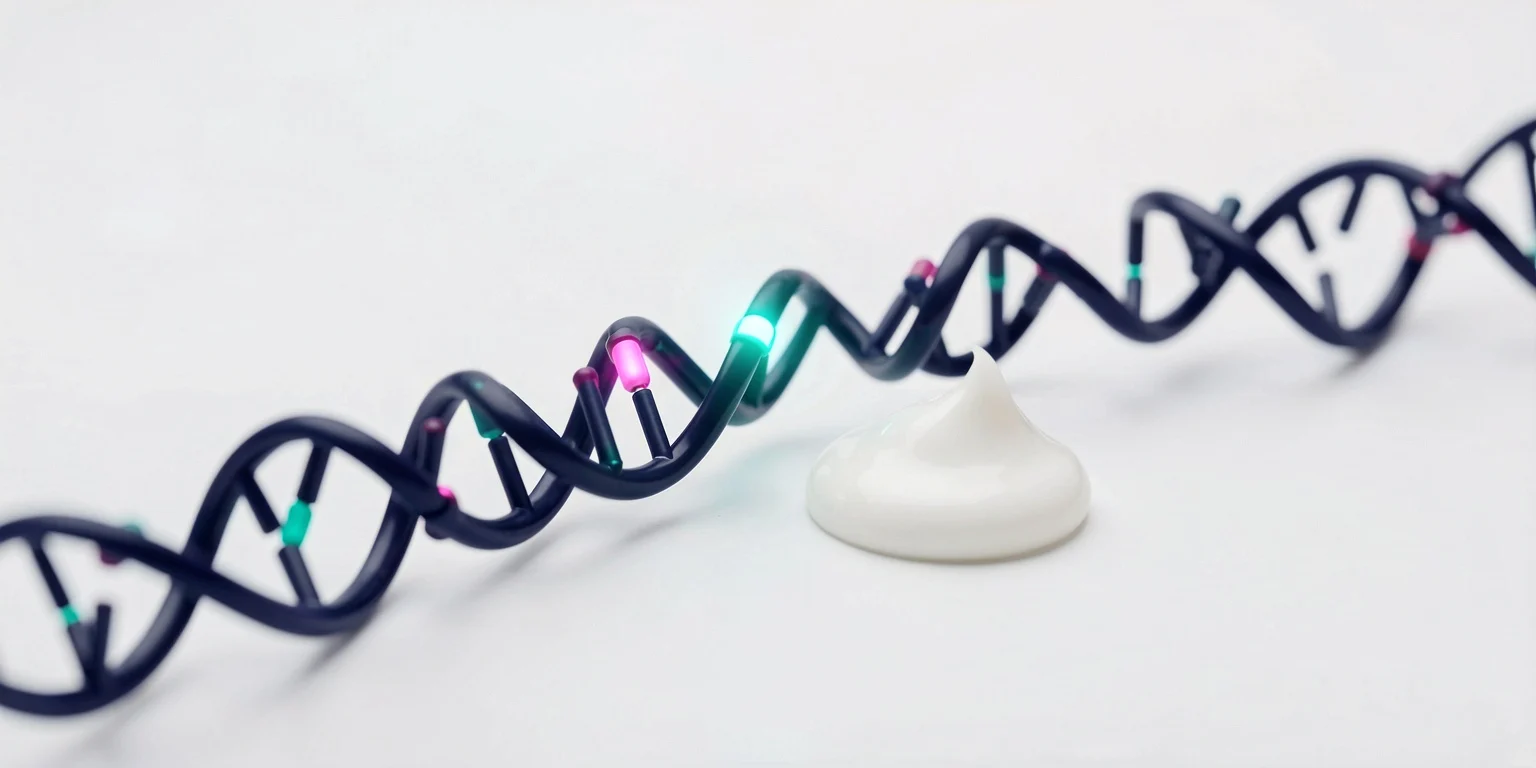
Nearly every mammal stops making lactase, the enzyme that digests milk sugar, soon after weaning. Most humans do too: MedlinePlus estimates that about 65 percent of people have a reduced ability to digest lactose after infancy. Yet hundreds of millions of adults drink milk without a second thought. The difference usually comes down to a single DNA letter, and the story of that letter is one of the clearest examples of recent human evolution you can read in your own raw data file.
A switch that sits outside the gene
The gene that encodes lactase is called LCT. The famous European milk-drinking variant is not in LCT at all. It sits about 14,000 letters upstream, inside a neighboring gene called MCM6, at a position researchers write as −13910 and consumer files list as rs4988235. The usual letter there is C, and lactase production winds down after childhood. The variant letter, T, keeps the switch on, so lactase continues into adulthood. One copy is generally enough.
That location is the first lesson the marker teaches. Nothing is broken or repaired in the enzyme itself; what changed is a regulatory region that decides when a normal gene stays active. A lot of human variation works this way: not different parts, but different timing.
The same trait evolved more than once
Milk drinking did not spread from one lucky ancestor. When researchers studied pastoralist communities in Tanzania, Kenya and Sudan, the European letter was largely absent. Instead they found at least three different letters in the same control region, each keeping lactase switched on, each arising on its own genetic background. The pattern around one of them suggested a selective sweep within roughly the past 7,000 years, among the strongest signals of recent natural selection found anywhere in the human genome.
Different populations, different mutations, the same outcome: biologists call that convergent evolution, and lactase persistence is one of its textbook human examples.
Why it spread is still an open question
The classic explanation is straightforward: herders with fresh milk had calories, water and protein their neighbors lacked, so the trait grew wherever dairying grew. Recent evidence complicates that tidy story. A 2022 study examined milk fat residues from about 7,000 pieces of prehistoric pottery across more than 550 European sites and compared 9,000 years of milk use against ancient DNA. How much milk a region used did not explain how fast the variant rose there. The authors propose that famine and infectious disease may have been the real filters: for a healthy adult, undigested lactose means discomfort, but for a malnourished or ill one, severe diarrhea can be deadly.
So the trait is real, the selection is real, and the reason is still being worked out. That is worth remembering whenever a genetic story sounds finished: the observation and the explanation are different things, and the explanation can change.
What your own file can say, and what it cannot
Lactase persistence is one of the most readable traits in a consumer DNA file, and still a good place to practice careful interpretation.
First, coverage: most consumer tests read the European letter reliably, but the African and Middle Eastern letters are not always on the chip. A file that shows C/C at rs4988235 belongs to a person who may still digest milk through one of the other switches. Evigenics checks the non-European switch positions when your file includes them before describing a milk reading, and says so when it cannot.
Second, genotype is not symptoms. People with the non-persistent genotype often handle a glass of milk, hard cheese or yogurt comfortably: the dose matters, fermentation removes much of the lactose, and gut bacteria adapt. And someone with the persistent genotype can still react to dairy for reasons that have nothing to do with this switch, including temporary lactase loss after a gut illness. A reading describes an enzyme’s genetic setting, not a diagnosis.
If you have a raw file from 23andMe or AncestryDNA, this marker is a rewarding one to look up, a single letter connecting your breakfast to several thousand years of human history. For the broader context, read what raw DNA interpretation can and cannot tell you and the privacy questions worth asking first. The milk reading in an Evigenics report covers this ground for your own file; it supports education and discussion with a qualified provider, not a medical diagnosis.